October 17, 2026
What An AI-Assisted Warehouse Refactor Looks Like, Phase By Phase
Seth Therrien
A warehouse migration can stall in a meeting where two reports disagree. Finance trusts one total, operations trusts another, and nobody can explain the difference. Until that disagreement is resolved, the new system cannot earn the confidence needed for cutover.
That problem starts before anyone selects a replacement platform. Business rules sit inside old SQL, stored procedures, reporting formulas, and scheduled jobs. Moving those rules without first agreeing what they mean simply moves the disagreement somewhere newer.
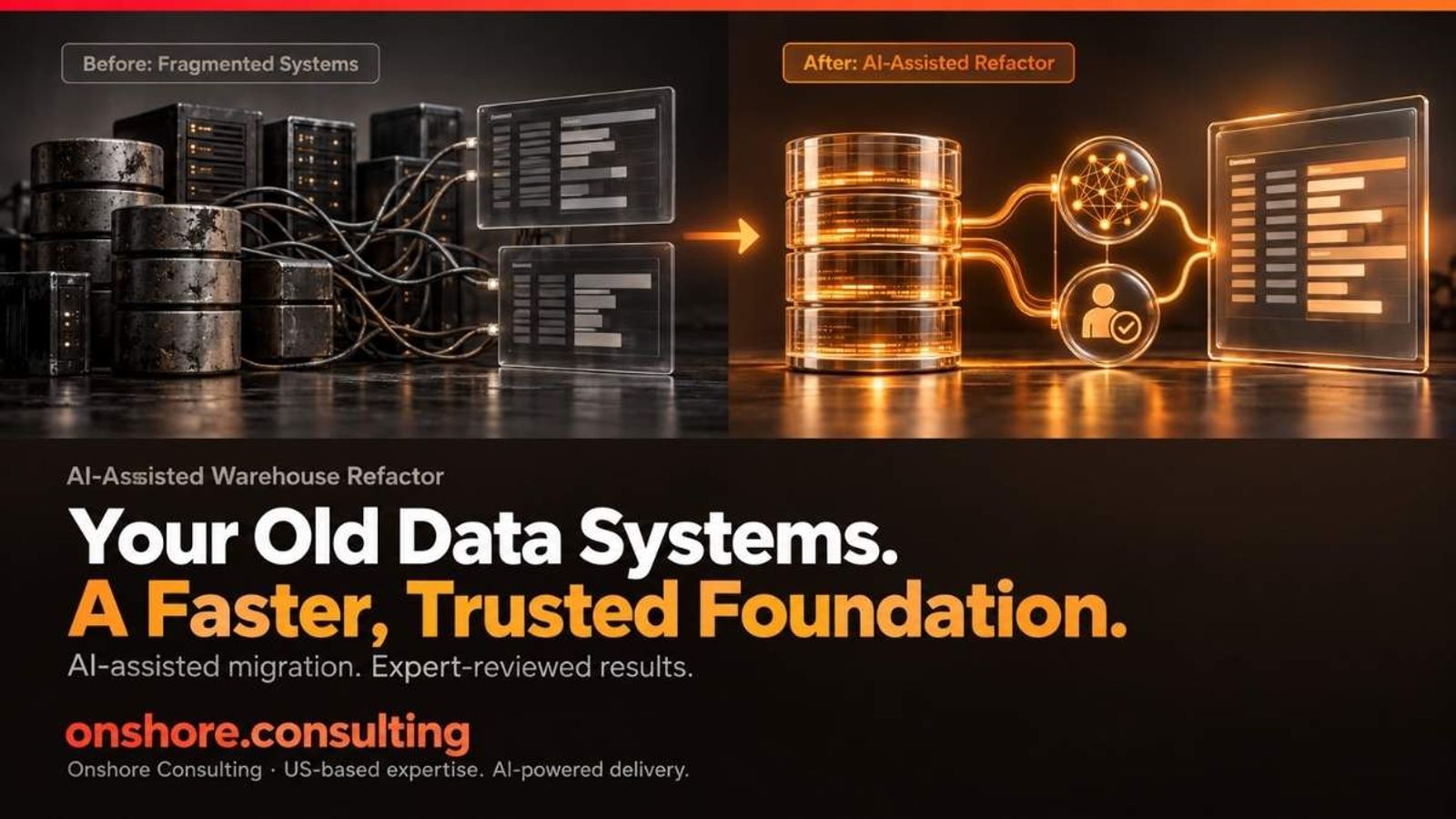
An AI-assisted warehouse refactor changes the sequence. Inventory comes first, acceptance tests come before replacement code, and AI handles much of the reading and drafting. A senior architect remains responsible for design decisions, while automated checks expose differences before users depend on the results.
For a data, BI, or IT lead, the benefit is practical. Less time disappears into code translation, repeated reconciliation, and rebuilding reports nobody needs. The following five phases explain how to move faster while keeping the business numbers accountable.
Why Warehouse Refactors Used To Stall
An old warehouse contains more than tables and queries. It also contains years of decisions that rarely reached the documentation. A filter added during an acquisition can still determine which revenue appears in today’s board report.
The challenge grows across SQL Server, Oracle, or Teradata environments connected to SSIS packages and SSRS reports. Power BI and Tableau can add another layer of calculations. Understanding a single business measure may require tracing logic through several places.
Reading Old Code Becomes The Critical Path
A manual rewrite asks people to reconstruct that history, often procedure by procedure. They must identify dependencies, explain calculations, and decide which unusual behaviors the business still needs. Development cannot move confidently while those questions remain unanswered.
AI can produce an initial explanation and proposed translation for review. It cannot decide whether an undocumented exception remains valid. That decision still needs an accountable technical lead and the business owner who understands the number.
Disagreement Keeps Both Systems Alive
When testing arrives late, different totals become a cutover problem. Teams export spreadsheets, compare summaries, and debate which calculation is authoritative. Meanwhile, people continue using whichever system they already trust.
The result can be a prolonged overlap in licenses, infrastructure, and support. A migration therefore needs an agreed retirement path from the start. Otherwise, the new platform becomes another system to maintain.
What Makes AI-Assisted Delivery Faster
The delivery method matters more than the presence of AI. Four choices make the speed credible and keep the work reviewable.
- AI does the reading and first draft. Legacy code, report definitions, explanations, documentation, and test drafts become reviewable starting points.
- A senior architect makes the design calls. One accountable lead decides grain, naming, structure, and technical trade-offs without repeated handoffs.
- Gates catch mistakes early. Specifications, tests, and review checks must pass before a change enters the shared codebase.
- Scope shrinks to what is used. Usage evidence identifies the reports and features worth rebuilding, alongside required dependencies and obligations.
I use my proprietary agentic AI software factory to read legacy logic and draft replacement artifacts. It organizes that work around specifications and checks, with senior review before changes are accepted. Its value comes from making repeated delivery tasks faster and easier to inspect.
The objection to modernizing used to be the migration itself. AI-assisted refactoring targets the reading and reconciliation work that makes that objection understandable. Design still needs judgment, but fewer hours need to disappear into preparing material for those decisions.
Phase 1 Inventory What Is Actually Used
Start by establishing what the business relies on today. A catalog of everything that exists is useful, but usage and dependency evidence determine the initial rebuild scope.
Follow Activity And Business Dependencies
Review available query logs, BI usage records, report subscriptions, scheduled exports, and job histories. Connect each active report to its source tables, transformations, and downstream consumers. Include spreadsheet extracts and application feeds that may never appear in dashboard statistics.
- Who uses this output, and which business decision depends on it?
- When was it last used, including seasonal or financial reporting cycles?
- Which jobs, tables, and hidden calculations keep that output working?
- Who can approve rebuilding, consolidating, retaining, or retiring it?
Low activity is evidence to investigate, not automatic permission to delete. An annual audit report may remain essential despite months without views. A table with no direct readers may still feed a critical process.
Turn The Inventory Into A Smaller Scope
Group the findings into active business outputs, required supporting components, and retirement candidates. Consolidate duplicate reports only after confirming their definitions and audiences. Record the owner and decision for each candidate.
This is the first speed gain. Every confirmed retirement removes translation, testing, documentation, and support work from the project. The amount saved depends on the actual estate, so the inventory should establish the evidence before anyone quotes a percentage.
The phase ends with an approved scope, a dependency map, and named business owners. A fixed-scope pilot can then follow one important measure from source data through to its final report.
Phase 2 Define Parity Tests Before Replacement Code
Parity means the replacement produces the agreed business result under equivalent conditions. Define that agreement before generating new models, while the existing system can still explain how it behaves.
Choose The Numbers Finance Already Trusts
Select approved measures such as recognized revenue, outstanding balances, or gross margin. Then document the calculation, reporting period, exclusions, currency treatment, and owner. A familiar report is a starting point, not proof that every historical rule is correct.
If the old calculation contains a known error, separate its correction from the migration. Record the approved change and its expected impact. Otherwise, a legitimate improvement can look indistinguishable from an accidental regression.
- Use equivalent source snapshots or matching extraction cutoffs for both systems.
- Agree the row identifiers and reporting dimensions used in comparisons.
- Define rounding, time zones, null handling, and permitted numeric tolerances.
- Include late records, reversals, cancellations, and important reporting boundaries.
Make Differences Traceable To Records
AI can read legacy SQL and draft comparison tests around its joins, filters, and calculations. The reviewer checks those tests against the approved business definition. Tests copied from old code alone can preserve the same old mistake.
Compare totals first, then drill into dimensions and business keys. For example, a hypothetical revenue mismatch might narrow to one location and its credited invoice lines. An automated comparison can expose those records when stable identifiers and equivalent inputs are available.
Without a reliable row key, the first task may be agreeing the comparison grain. That means deciding what each comparison row represents, such as one invoice line. Record counts and totals help, but matching totals can still hide offsetting errors.
The approach fits dbt’s data testing model, where checks can return failing records. Business reconciliation requires additional tests written for the agreed definitions.
The phase ends with approved acceptance criteria and baseline results. Replacement models can then be developed against a clear contract, rather than an argument waiting for cutover.
Phase 3 Rebuild On Snowflake With dbt Or Coalesce
With scope and acceptance criteria established, rebuild the necessary transformations on Snowflake. Use dbt or Coalesce to organize that transformation work according to the team’s delivery and maintenance needs.
Use AI To Prepare The Implementation
For each in-scope component, AI reads the existing logic and drafts its replacement model, documentation, and tests. The draft should explain its sources, business rules, dependencies, and unresolved questions. An unexplained translation is difficult to review, however quickly it appears.
A stored procedure may contain several responsibilities, including loading data, updating records, and preparing report outputs. Those responsibilities need explicit treatment. Copying the procedure into new SQL does not establish that its behavior belongs in the same structure.
Keep The Design Decisions Accountable
The senior architect decides how the replacement should work and reviews the proposed implementation. Business owners confirm measure definitions and exceptions. One accountable technical lead shortens decision chains while preserving the approvals that require business authority.
- Grain defines what one row represents, preventing accidental duplication during joins.
·- Naming makes shared concepts recognizable across models, reports, and documentation.
- Incremental strategy determines how changed, late, and deleted records are handled.
- Cost review checks processing frequency, data volume, and actual workload behavior.
For example, dbt incremental models can process a selected subset of data after an initial build. The design must still identify which records need reprocessing and how updates remain correct.
For an invoice model, newly created invoices may be straightforward. Later credits, corrected invoice dates, or removed records require additional rules. A faster refresh is useful only when those rules preserve the approved reporting result.
Make Checks Part of Every Change
Before a change merges, review its specification, compile or build it, and run the relevant tests. Check keys, required fields, relationships, and reconciliation results. Review documentation alongside the model so future maintainers receive the same explanation.
AI-generated tests also need scrutiny. If the model and its tests share the same misunderstanding, both may appear correct. Independent baseline comparisons and business review provide checks beyond the generated draft.
The phase ends when the in-scope models meet their acceptance criteria and operational requirements. Unresolved differences remain visible, with an owner and an agreed resolution.
Phase 4 Rebuild The Dashboards People Use in Hex Or Omni
The new reporting layer should support the decisions identified during inventory. Recreating every old screen carries unused work forward and repeats calculations that should have been standardized.
Put Shared Definitions Beneath The Reports
A semantic layer defines common measures, dimensions, and relationships for analysis. In practical terms, it gives revenue, customer, and location consistent meanings across approved reporting. Users can ask follow-up questions against those definitions without recreating the calculation each time.
Hex supports semantic models that can be authored directly or connected from supported external platforms.
Omni centers its analytics on a semantic layer. In either environment, useful self-service depends on accurate definitions, suitable permissions, and reviewed relationships.
Choose the reporting tool around the users and their work. The acceptance test is whether they can complete the same business task reliably. Matching the previous screen’s colors and chart positions matters less than preserving its meaning.
Test The Report As Users Experience It
- Confirm filters, date ranges, drill paths, and export behavior with users.
- Check that permissions expose the correct records to each audience.
- Compare displayed totals against approved measures and equivalent refresh cutoffs.
- Assign an owner for definitions, user feedback, and future report changes.
AI-first analytics can help users explore the data, but the question still needs a dependable foundation. An incorrect relationship can produce a persuasive answer with the wrong total. Shared definitions and reviewed access rules keep that risk visible.
The related article The most expensive dashboard is the one nobody uses explains why report activity should shape rebuilding decisions. Inventory is also how the new reporting estate stays smaller and easier to maintain.
The phase ends with approved reports, reviewed access, and users who can complete their essential tasks. A dashboard becomes ready through that evidence, rather than through a successful demonstration alone.
Phase 5 Run In Parallel Then Cut Over And Decommission
Parallel running provides controlled evidence for switching systems. Define its purpose and exit conditions before it begins, so overlap does not become the permanent operating model.
Run A Controlled Comparison
Compare both environments using equivalent data cutoffs and the approved test suite. Include the reporting events that matter to the business, such as a close or reconciliation cycle. Investigate failures through the agreed comparison keys and definitions.
A green test suite supports the decision, but operational readiness matters too. Reports must refresh reliably, permissions must work, and support owners must know how to respond. Users need a clear destination for their work and a place to report problems.
- Confirm critical parity tests pass within the approved acceptance rules.
- Obtain business approval for reports and any explicitly accepted differences.
- Validate refresh behavior, workload performance, access, and operational monitoring.
- Document the cutover sequence, rollback conditions, and responsible decision makers.
Retire The Old System Deliberately
After cutover, confirm that users, scheduled jobs, exports, and application dependencies have moved. Preserve required records and recovery material under the agreed retention policy. Then remove obsolete access, retire redundant jobs, and close the relevant infrastructure and licensing obligations.
This is where planned savings become measurable. A license may remain payable until its contractual cancellation date. Server costs fall only when the resources are retired, and support effort falls only when duplicate processes stop.
Compare the new operating costs with the previous baseline, including compute, storage, subscriptions, and maintenance effort. Faster delivery creates an earlier opportunity to remove overlap. Actual savings still depend on workload choices and completed decommissioning.
How The Work Changes With AI Assistance
The comparison below describes common manual bottlenecks and the delivery method used here. Traditional projects can also apply strong tests and scope controls; AI makes much of the preparation faster.
| Task | Traditional rewrite bottleneck | AI-assisted and senior-reviewed |
|---|---|---|
| Reading legacy SQL and procedures | Manual reading and translation | AI explains and drafts; the architect reviews |
| Writing tests | Tests may arrive late under deadline pressure | Test drafts accompany every in-scope model |
| Documentation | Documentation follows implementation | Model and documentation are drafted together |
| Finding a parity gap | Spreadsheet comparisons and repeated meetings | Automated comparisons isolate mismatched records |
| Scope | Rebuilds can follow the existing catalog | Usage, dependencies, and obligations define scope |
The advantage is cumulative: fewer unnecessary components, quicker preparation, and differences exposed while they are still inexpensive to fix. None of those gains requires treating generated code as approved code.
Experience Behind The Delivery Method
My background includes more than 20 years in data and AI architecture. At Avalara, I grew a data organization from 1 to 24, worked at petabyte scale on Snowflake, and helped more than 2,000 data and analytics users work with data.
That experience informs where I keep human review concentrated: business definitions, model structure, operational trade-offs, and acceptance decisions. AI helps prepare the material, while accountability stays with the person responsible for delivery.
Experience with SOX, SOC 2, and GDPR at Avalara also informs the questions I ask about access and evidence. Those obligations need explicit project requirements and review. They are not automatic properties of AI-generated code or a replacement warehouse.
I refactor onto Snowflake, dbt or Coalesce and AI-first analytics like Hex or Omni in a fixed-scope pilot, using AI-assisted migration, so the move costs a fraction of a traditional rewrite.
A fixed-scope pilot makes the approach concrete. Choose a business output with a known owner and traceable inputs. Demonstrate the inventory, comparison tests, reviewed model, report, and cutover requirements before expanding the work.
For the wider business case, read Custom analytics and why the math has changed. The same discipline applies: evaluate the work needed, the operating model, and the evidence behind any cost claim.
Three Questions To Ask Any Migration Vendor
Do You Inventory Usage Before Defining The Rebuild?
Ask how the vendor combines activity logs, dependency mapping, and business-owner review. A credible answer explains how retirement candidates are approved and how essential infrequent reporting remains protected.
If the proposal assumes every existing object must move, ask what evidence supports that assumption. Scope should follow business need rather than the size of an inherited catalog.
Do You Define Parity Tests Before Cutover?
Ask when acceptance criteria are agreed, which baseline numbers are trusted, and how discrepancies are investigated. Request a sample comparison output that identifies mismatched records or the relevant business dimensions.
The tests should shape development from the beginning. A promise to compare dashboards at the end leaves the hardest questions unresolved until switching becomes urgent.
Who Reviews The AI Output And Owns The Decisions?
Ask who approves model structure, business logic, access requirements, and performance trade-offs. Clarify which checks block a merge and who can authorize exceptions.
A useful answer names an accountable senior reviewer and describes the evidence needed for approval. Generating code faster has limited value when nobody can explain why it is correct.
Start With The Numbers The Business Trusts
A faster warehouse refactor begins with evidence about usage and agreement about the numbers. AI then reduces reading and drafting work, while senior review keeps design decisions accountable.
Build only the required models and reports, prove them against approved tests, and make retirement part of delivery. That sequence gives the business a clear basis for switching systems.
The project finishes when trusted reporting works and the old estate can close.
If your warehouse or reports are overdue for a move, book a free strategy call at onshore.consulting.