October 25, 2026
Before Your First Data Engineer Starts: Build The Foundation While You Hire
Seth Therrien
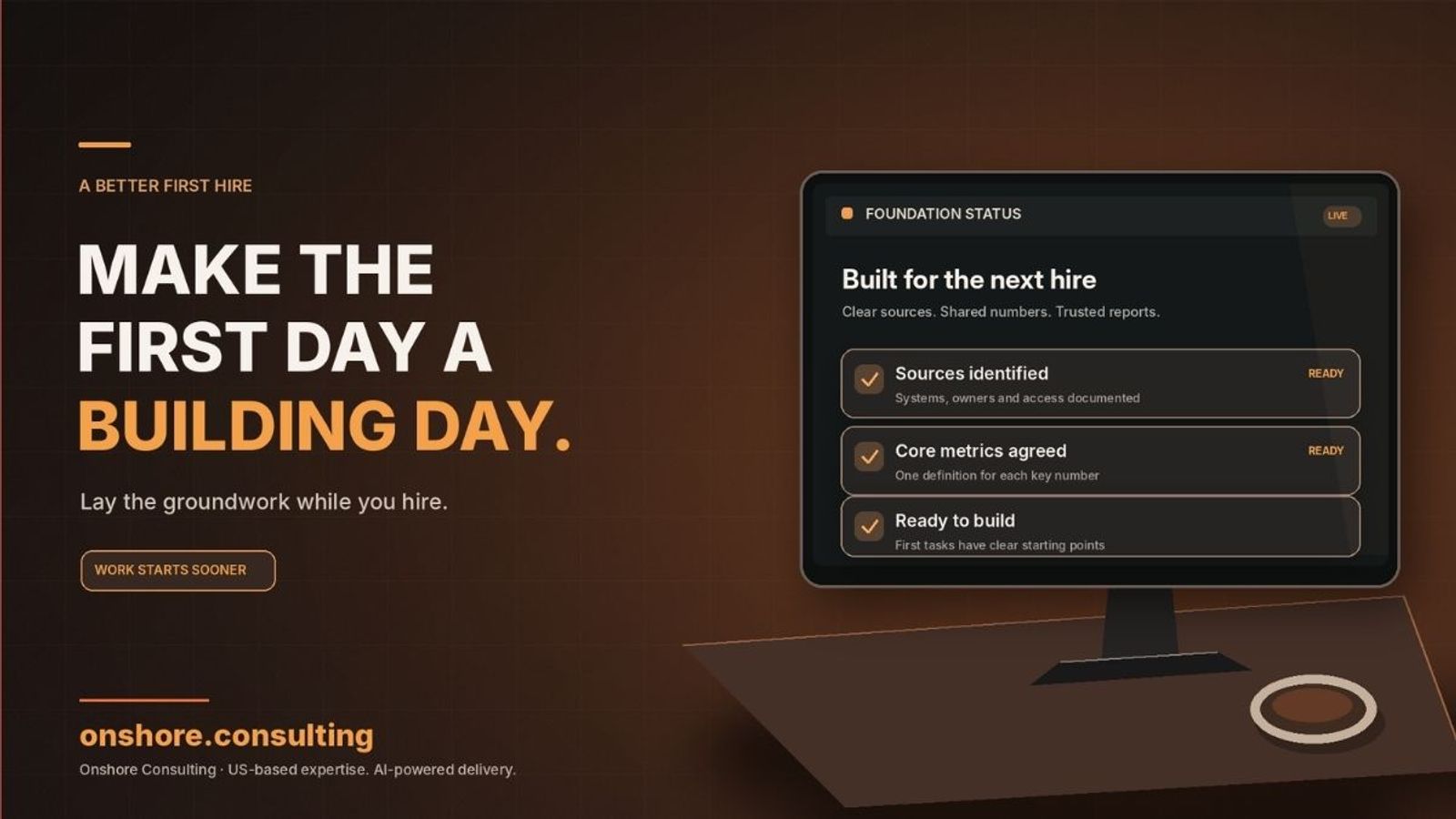
Most first data engineers spend their early months on archaeology: finding where the data lives, who owns it, and why two systems disagree. You can hand them a map instead.
The job description says you need someone to build pipelines, improve reporting, and make your data useful. But when that person arrives, the first assignment is often deciphering undocumented spreadsheets, reconnecting fragile integrations, and negotiating what “revenue” means. None of that requires your new hire to be the person who discovers the problem.
If you are recruiting your first data engineer or analytics engineer, the hiring process and the foundational data work can run in parallel. Hiring takes as long as it takes. The foundation does not have to wait for it.
What Your First Data Hire Actually Inherits
A growing company rarely starts with a blank slate. It starts with years of decisions made by finance, operations, sales, and whoever happened to know SQL. Those decisions kept the business moving, but they can leave the next engineer with a confusing starting point.
Scattered Sources Without A Reliable Map
Customer records live in the CRM. Invoices live in accounting software. Orders, subscriptions, support tickets, and product activity live elsewhere. Each system has different identifiers, update schedules, access permissions, and owners. If nobody has documented the connections, a new hire must interview departments before designing a single useful pipeline.
The problem is not the number of tools. It is the lack of a clear answer to three questions: where does this number come from, who can explain it, and how does it reach the report?
Spreadsheet Pipelines and A BI Tool Doing Warehouse Work
Someone exports a CSV every Monday, cleans it in a workbook, and pastes the result into a dashboard. Another person uses calculated fields in the BI layer to fix inconsistent source data. Both solutions may work until the owner takes leave, a field name changes, or reporting needs to scale.
A BI tool should help people explore trusted data, not serve as the only place business logic exists. Otherwise, every new dashboard becomes another version of the same cleanup job.
Metrics That Change Depending On Who You Ask
Finance may count recognized revenue. Sales may report bookings. Operations may remove canceled orders from its totals. All three views can be legitimate, but only if their meanings are documented.
Without agreed definitions, the engineer can produce a technically correct pipeline that still gives leadership an answer nobody trusts.
For the business cost of this reporting pattern, see Your CFO Is Your Most Expensive Data Engineer.
The Three Things To Have Ready
You do not need an enterprise data platform before the job offer is accepted. You need a small, documented starting system that tells the engineer what exists, what “correct” means, and how new work should fit together.
1. Build A Source Inventory
List the systems that contribute to decisions the business makes regularly. Start with the reports people actually use, then trace their inputs backward. A source inventory should identify each system, its business owner, the important tables or exports, how data leaves it, update frequency, access requirements, and known quality problems.
For example, if the weekly sales report depends on CRM opportunities and finance invoices, record both sources and the rule that connects them. If customer IDs are inconsistent or refunds arrive late, document that before creating a transformation.
Deliverable: a simple source map and an owner for each critical feed, not a diagram covering every application the company has ever bought.
2. Establish A Warehouse and Modeling Convention
Choose the smallest architecture that supports your reporting and operational needs. Snowflake may be an appropriate warehouse; dbt or Coalesce may fit the transformation layer. Those are options, not mandatory purchases. Existing tools, security requirements, skills, and usage should guide the choice.
The important early decisions are less glamorous: what one row represents in each core table, how tables and fields are named, how raw data is separated from trusted models, and how changes are reviewed. A naming standard and a repository structure save the new engineer from repeatedly settling the same arguments.
Add checks for null identifiers, duplicate primary keys, valid relationships, and reconciliation against known-good values. Tests should confirm business meaning as well as successful execution. The dbt testing guidance offers concrete examples of these controls, while dbt workflow guidance covers naming, source definitions, and review practices.
Deliverable: one documented path from a source to a tested model, with clear conventions the hire can extend.
3. Define The Ten Numbers Leadership Debates
Ask leaders which figures repeatedly trigger reconciliation meetings: revenue, gross margin, active customers, churn, bookings, utilization, or another measure relevant to the business. Choose the most-used metrics first; ten is a practical starting target, not a requirement to invent ten.
For each metric, document its business owner, plain-language definition, source tables, calculation grain, time window, exclusions, and one known-good sample. “Monthly active customer,” for instance, might mean a customer with a completed paid transaction during the calendar month, excluding test accounts and fully refunded orders. Finance and operations should approve the definition before code implements it.
Deliverable: a short, signed-off definitions list that prevents three departments from commissioning three competing versions of the truth.
What To Build First, and What to Leave For The Hire
Foundational work should make the new employee productive, not remove every meaningful decision from the role. The right scope is narrow enough to hand off cleanly and useful enough that people can already see its value.
Build The Smallest Trusted Data Foundation
Start with the warehouse environment or equivalent central data store, basic access controls, a repository, and the first reliable ingestion paths. Model a small group of shared entities such as customers, orders, or invoices. Then publish a few metrics that leadership already needs.
Each pipeline should have an owner, a refresh expectation, a failure path, and tests that run before changes reach the trusted layer. Where source data is sensitive, use appropriate permissions and review practices rather than copying raw exports into uncontrolled workspaces. Snowflake’s governance documentation outlines examples of access, classification, and monitoring controls that can inform the design.
This first slice becomes both a working system and a reference example: the next engineer can see how sources, transformations, checks, and reporting fit together.
Leave Business-Specific Expansion To The New Engineer
Do not prebuild every departmental dashboard or model every possible edge case. Work that requires daily proximity to product, finance, or operations is often better owned by the permanent hire. They should refine source coverage, optimize performance, maintain documentation, and deepen relationships with the people who use the outputs.
Give the engineer enough structure to move confidently, with room to challenge assumptions and improve the architecture. A good foundation supports ownership; it does not lock the team into somebody else’s undocumented choices.
How To Know The First Month Is Working
The test is not how many tickets the engineer closes or how much SQL they write. It is whether the business and the engineer can produce useful changes without rebuilding context from scratch.
Look For Work That Reaches Real Users
A meaningful early win might be an automated finance reconciliation, a reliable customer activity model, or a report that no longer depends on a manual export. Choose an output with a business owner who can verify it, not a technically impressive demo with no audience.
Ask whether the engineer can trace a reported number to its source, explain the agreed definition, add a test, and make a change without introducing a conflicting answer. When they can, the groundwork is reducing risk instead of merely producing documentation.
Watch What Stops Requiring A Spreadsheet
Track a few indicators rather than a large new scorecard: recurring reports no longer assembled by hand, source owners identified, core metric disputes resolved, and the time between a business request and a verified answer. Record the baseline before the work begins so improvements are observable.
One useful signal is simple: leadership asks a new question, and the team answers it from the trusted model instead of starting another workbook.
The Option Most Companies Miss
A company with an open data role often treats the foundation as work only that future employee can do. That makes recruitment the critical path for decisions that could already be made.
Bring In Senior Architecture Before The Hire
A senior architect can map the current systems, make the first modeling decisions, agree on metric definitions, and build a limited working foundation while interviews continue. The permanent engineer then joins a project with meaningful context, working code, tests, and a backlog shaped by business priorities.
At Onshore Consulting, the architectural work is led by Seth Therrien, who has more than 20 years of data and software experience and grew a data organization from one person to 24. That experience matters at this stage because the challenge is not only choosing a stack. It is knowing which decisions must be settled before the team expands. The career background is documented on the Onshore proof page.
Use AI for Throughput, Not Unreviewed Decisions
Speed comes from changing how the foundational work is executed. AI can read legacy SQL, stored procedures, report definitions, and old application code, then help produce the first draft of documentation, models, and tests. That reduces manual investigation, but it does not make the business decisions.
A senior architect owns data grain, naming, structure, and trade-offs. A specification describes the intended result. Automated checks, independent reconciliations, and review gates determine whether an AI-assisted change is safe to accept. Usage inventory keeps the scope centered on the reports and features people rely on.
That is the approach behind my proprietary agentic AI software factory: bounded tasks, explicit specifications, test evidence, and senior approval before a change counts as complete. The aim is not to generate the most code. It is to produce a dependable foundation with less avoidable investigation and rework.
For a deeper explanation of separating AI reasoning, implementation, and independent verification, read Two Brains, One Pipeline: AI-Assisted Data Work.
First Data Engineer Readiness Checklist
Use this checklist before your hire arrives. If some items are unfinished, make them explicit handoff tasks with an owner rather than leaving them as surprises.
- Critical systems identified: the sources behind the reports people use most are listed.
- Source owners named: each important feed has a person who can explain its meaning and access.
- Data movement mapped: exports, APIs, refresh schedules, and known failures are recorded.
- Core architecture chosen: the initial storage and transformation approach has a documented rationale.
- Modeling standards written: grain, identifiers, naming, and layer boundaries are clear.
- Access reviewed: permissions and sensitive-data handling match the company’s needs.
- Top metrics defined: leadership has approved the rules and exclusions for priority numbers.
- First pipelines tested: core loads have checks, monitoring, and a recovery owner.
- Known-good outputs saved: at least a few important totals can be reconciled independently.
- Handoff prepared: the engineer has a repository, runbook, stakeholders, and a prioritized backlog.
Make Day One A Building Day
Your first data engineer should not have to earn the right to build by spending their first stretch finding forgotten exports and reconstructing decisions. If the core sources, conventions, and metrics are already in place, they can spend that effort improving what the business uses.
Hiring and architecture are related projects, but they do not have to be sequential. Start the work that is clear now. Leave the ongoing ownership and business-specific depth to the person you hire.
Hiring your first data engineer? Book a free strategy call at onshore.consulting and get the foundation started now.