October 23, 2026
AI-Assisted Delivery Vs. Vibe Coding: What Sets Them Apart?
Seth Therrien
Anyone can get AI to write a thousand lines of code in an afternoon. The question a buyer should ask is what happens to those lines on the day something breaks.
A demo may look finished because the happy path works. A form saves a record, a dashboard loads, or an assistant produces a reasonable answer. None of those moments proves that a second feature will work beside the first, that permissions are correct, or that the next release will not break something customers already use.
That is the problem behind much of the debate about vibe coding. Generating software quickly is useful. Treating generated output as completed engineering is where speed starts creating debt.
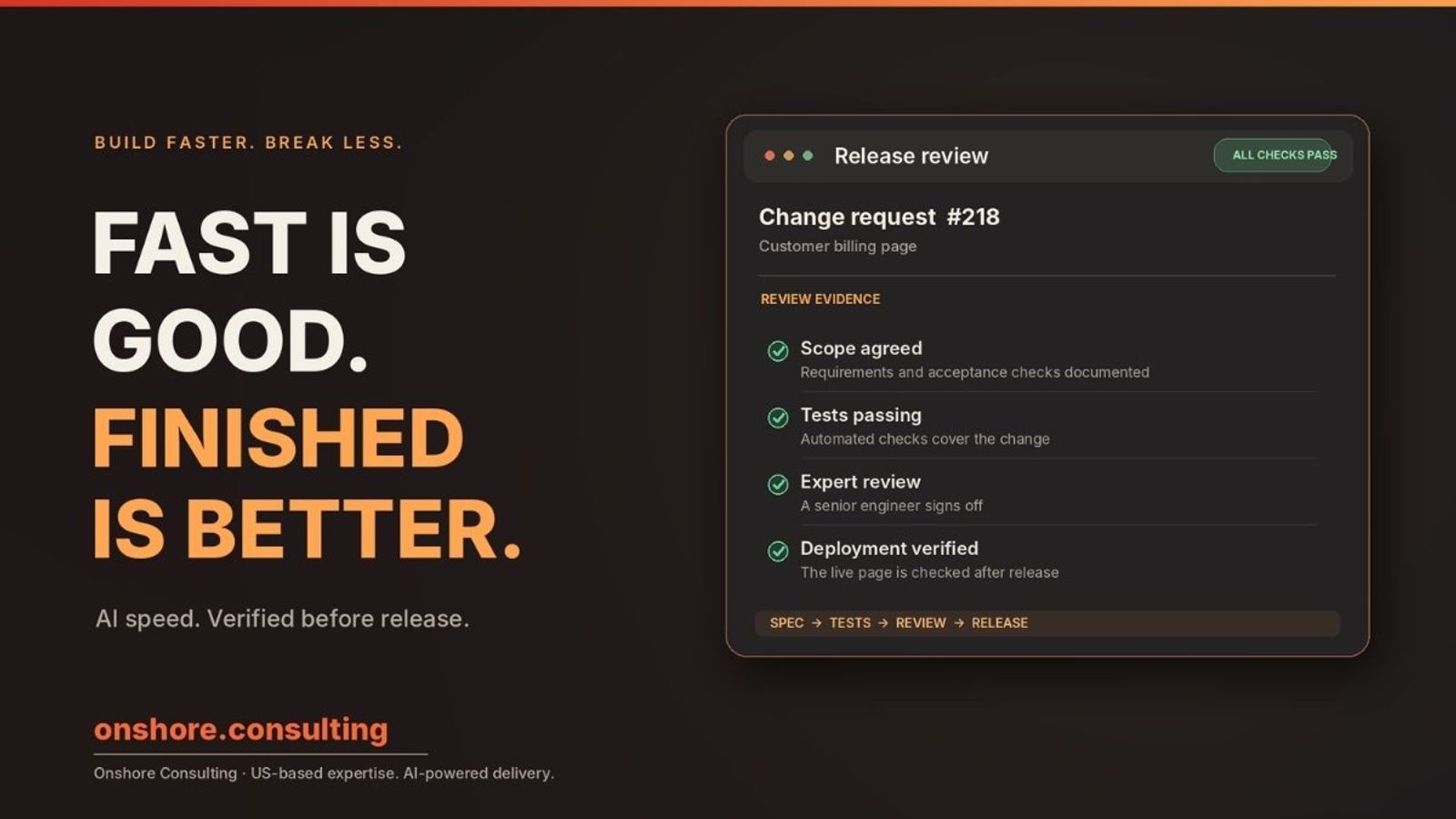
The difference becomes visible in the pull request, the proposed code change a team reviews before accepting it. Does the change point to an approved requirement? Does it include tests? Can a reviewer see what failed, what passed, and what actually ran after deployment?
My view is simple: real AI-assisted delivery moves quickly because the work passes clear gates, not because the gates disappear. Speed without evidence is borrowed time.
What Vibe Coding Actually Produces
Vibe coding is useful for making an idea tangible, but a working screen is not the same as a dependable product.
The term describes a style of building where someone prompts an AI tool, tries the result, and keeps asking for changes until it appears to work. For a disposable experiment, this can be a sensible way to learn. It lets a founder test a concept without first building a full team.
Problems begin when the same loose process becomes the release process. Changes may arrive without tests, documented decisions, or checks on neighboring features. The person accepting the code may have no record of why a particular approach was chosen.
When A Quick Prototype Becomes A Product
The second feature often exposes the debt hidden inside the first.
A login flow works until a new customer role requires different access. A report loads until another data source changes the meaning of one field. A form submits until an error path leaves half a transaction saved.
At that point, the team is no longer paying for code generation. It is paying to reconstruct assumptions, isolate failures, and repair interactions nobody tested together. The cleanup bill is a delivery problem, not an argument against AI.
Spec First: Define Done Before AI Starts
The fastest safe change starts with a small written agreement about the result, its limits, and how success will be checked.
A specification does not need to be a long requirements document. It needs to remove the decisions an AI agent should not invent. That means stating the user goal, the important constraints, the expected behavior, and the evidence that will count as completion.
The Four Things Every Change Needs
- Goal. Describe the user or business result, not only the file that should change.
- Constraints. Record permissions, existing behavior, dependencies, and anything that must remain unchanged.
- Acceptance Test. Describe a check that would fail if the promised behavior were missing.
- Stop Condition. Require the agent to surface uncertainty rather than guess at an important decision.
For example, “add export” is a request. “Allow authorized managers to export only the filtered records they can already view, and reject unauthorized requests” is a testable change. The distinction saves review time and protects customers.
How Specs Make Parallel Work Possible
Parallel AI workstreams only save time when they share boundaries and a common definition of finished.
A senior technical lead can assign independent tasks for the user interface, data handling, and validation. Each task has a narrow scope, known interfaces, and its own tests. Conflicts are resolved at the specification level before separate changes collide in the main codebase.
This is also where configuration can be preferable to another custom function. If thresholds, labels, or mappings change regularly, putting approved values in a controlled configuration file makes the next update easier to inspect without rewriting core logic.
The Gates That Fail Loudly
A quality gate is a check that stops a change when the evidence is not good enough.
Useful gates include code validation, automated tests, checks on integrations, and a final review of the deployed behavior. The goal is not to create paperwork. It is to turn known risks into automatic reasons to stop before customers see them.
A Missing Import That Passed The Build
A failure in one of my own products showed why a green build is not always a meaningful signal.
A page referenced an import that did not exist. The project still passed its build process, and the page later returned an error in production. The immediate repair was straightforward: correct the missing import. But that only addressed one occurrence.
The more important question was why the build had approved code containing that failure. A passing status was giving confidence the process had not earned.
Fix The Failure Class, Not Only The File
The lasting fix was to make the build fail whenever that kind of missing name appeared again.
The check was changed, then tested deliberately by introducing the same failure. Only after the build rejected it could the new gate be trusted. The important deliverable was not just a repaired page. It was a repeatable way to catch the next missing import before release.
That distinction matters to buyers. Someone can patch a bug quickly and still leave the delivery process unchanged. A stronger team identifies the class of defect, adds an appropriate check, and proves that the check fails when it should.
Not every production failure can be prevented by one automated test. But every significant failure should lead to a clear decision about what can be checked earlier, who owns that check, and what evidence will show it is working.
Evidence Belongs In Every Pull Request
A completed pull request should tell a reviewer what was requested, what changed, and why the result is safe to accept.
It should not ask the reviewer to trust the developer, the agent, or a screenshot alone. A practical completion record can be short, provided its contents are specific and can be checked.
- Approved Spec. The exact requirement and acceptance criteria this change is meant to satisfy.
- Test Results. The checks that ran, what they cover, and whether any failures remain.
- Quality Gates. Build validation, relevant security checks, and other required controls that blocked or passed the change.
- Human Review. A named reviewer who can explain the important decisions and unresolved risks.
- Deployed Verification. Confirmation that the intended behavior was checked in the actual deployed environment.
That final point is easy to miss. A test environment can pass while the deployed configuration, permissions, or external dependency behaves differently. Reading the result back after deployment closes the gap between “merged” and “working.”
I treat this trail as part of the product, not an administrative extra. It makes defects easier to investigate, later changes easier to review, and handoffs less dependent on one person remembering the details.
Why Controlled AI Delivery Actually Moves Faster
The economic gain comes from cutting waiting, repeated reading, and avoidable rework, not from removing engineering judgment.
There are four reinforcing reasons AI-assisted work can move faster without making quality an afterthought.
1. AI Handles The Reading And First Draft. Legacy SQL, stored procedures, report definitions, and application code can be explained and redrafted faster, leaving people to validate behavior and settle exceptions.
2. One Senior Lead Makes The Calls. A responsible technical decision-maker settles naming, data definitions, system boundaries, and trade-offs instead of passing open questions across multiple handoffs.
3. Gates Catch Errors Before They Spread. A failed check close to the change is cheaper to resolve than a production defect that reaches other features and business processes.
4. Scope Starts With Actual Usage. An inventory of what people use prevents the team from rebuilding abandoned reports, old features, and behavior nobody still needs.
Also Read: AI-Assisted Warehouse Refactor Phases
Senior Judgment Is Not The Bottleneck
AI changes where experienced judgment adds the most value.
I bring more than 20 years of data and AI delivery experience to those decisions. In a prior leadership role, I grew a data organization from one person to 24 and supported analytics used by more than 2,000 people. Those are career credentials, not a claim that every new project has the same scale.
My proprietary agentic AI software factory runs multiple bounded workstreams in parallel. Each one must clear the relevant specifications, tests, and review gates before its output is accepted. That is how the work can move quickly while responsibility stays with a person.
Config Over Code Keeps Changes Small
Repeated business rules should not require repeated custom rewrites when a controlled setting would do the job.
Consider an application with client-specific approval limits or a data loader with source-specific column mappings. Keeping those values in reviewed configuration can reduce the amount of code touched by each change. Fewer changed surfaces mean a smaller review and more focused tests.
Configuration still needs validation, access controls, and version history. It is not an excuse to hide business logic. Used deliberately, it reduces routine code churn and makes approved changes easier to trace.
Five Questions To Ask Anyone Who Says They Build With AI
A buyer does not need to inspect every line of code to establish whether the delivery process is credible.
Ask these five questions before approving a pilot or accepting a claim that AI makes delivery faster.
1. Where Is The Spec? Ask to see the goal, constraints, assumptions, and explicit exclusions for a recent change.
2. What Test Proves It Is Done? Ask for an acceptance test tied to the user outcome, not just evidence that code compiled.
3. What Fails The Build? Ask which defects stop a change automatically, and how the team has verified that those gates work.
4. Who Reviews The Change? Ask who owns system decisions and who can explain the trade-offs made by the AI workstream.
5. What Evidence Do I Receive? Ask for the test record, review history, and proof the deployed behavior was checked.
Listen for concrete answers. A credible provider can show a recent change from specification to verified result. If every answer is “the AI handles that,” there is no clear owner when something goes wrong.
What A Buyer Should Expect At Handoff
The deliverable should include working software and enough evidence for the next person to maintain it.
That means source code, the approved specifications, relevant tests, configuration, the record of known limitations, and clear operating instructions. The client should know who approved important decisions and what needs attention if a dependency changes.
This expectation also makes a fixed-scope pilot more useful. Rather than committing to a large rewrite on a promise, choose one feature or workflow people genuinely rely on. Define what correct behavior looks like, insist on visible gates, and review the resulting evidence before extending the scope.
For a related explanation of separating decisions from AI execution, see our guide on, two brains, one pipeline: ai-assisted date work.
Conclusion
Fast code is easy to produce. Reliable change is harder, and much more valuable.
The practical difference between vibe coding and professional AI-assisted delivery appears in the pull request. One process shows output. The other shows requirements, checks, human judgment, and a deployed result that has been verified.
Speed without gates simply moves the bill downstream. Speed with evidence makes the next change safer than the last.
Want AI speed with work you can trust? Book a free strategy call at Onshore Consulting.