November 13, 2026
What A CTO Should Require Before Coding Agents Touch Production
Seth Therrien
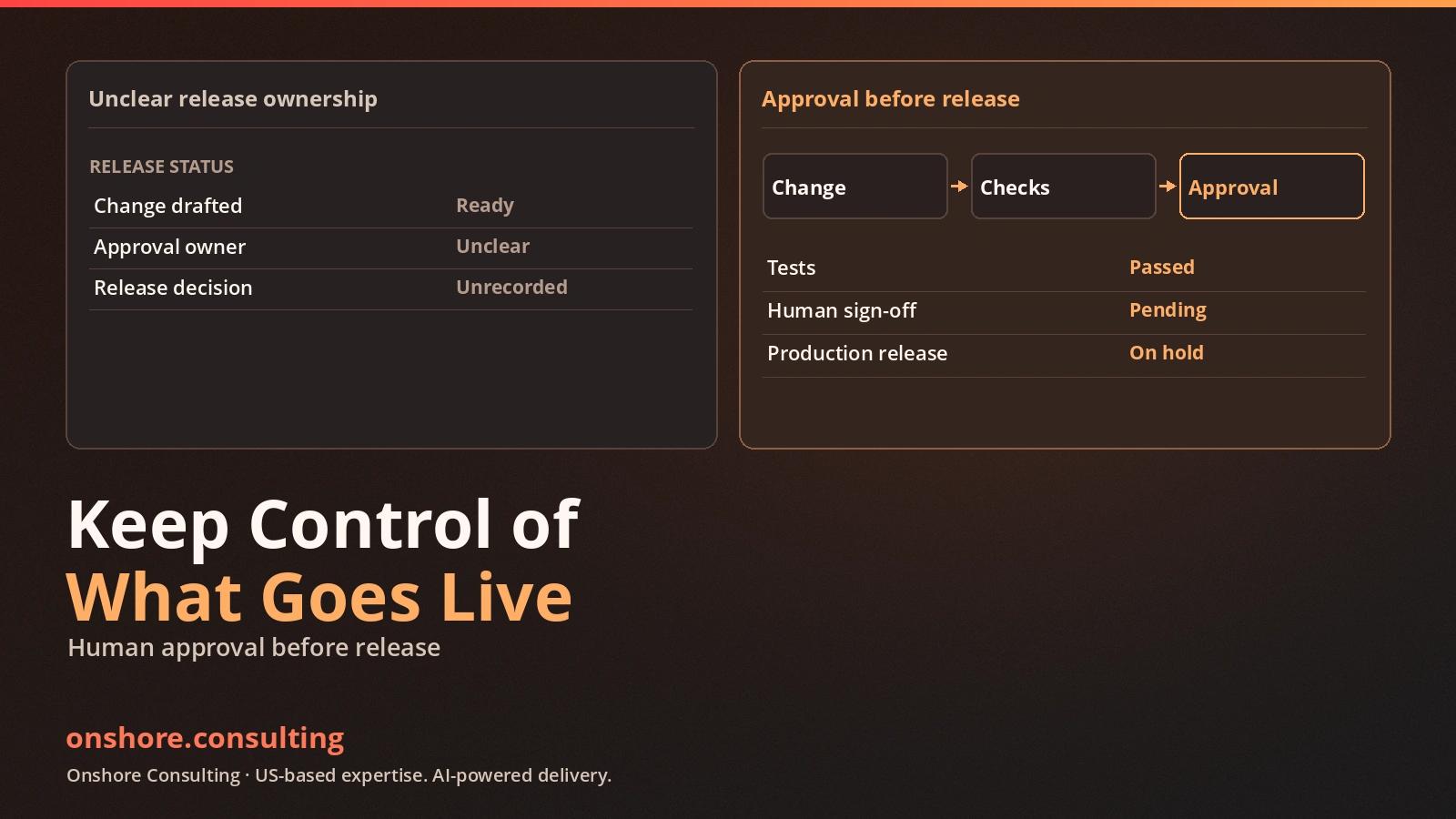
An agent can open a pull request before anyone agrees what it may change. A CTO must define production rules before granting repository access.
Major coding platforms now expose organization policies, repository access settings, permission rules, and session approvals. Some also support managed settings, model selection, and project instructions. The controls differ by product, plan, and deployment, so a policy must describe required behavior rather than assume identical settings.
This shifts the central question facing every CTO. The decision is no longer whether an agent can write code. The decision is what it may read, change, execute, and release.
Treat an agent like a new senior hire, then add machine-specific controls. Humans still own production actions, secrets remain outside prompts, and destructive operations require hard limits. Every change needs reviewable evidence, and each repository must explain what good work looks like.
What Changed In The Tools
GitHub's current administration controls let organizations manage feature and model availability. They also let administrators enable third-party coding agents and limit access by repository.
GitHub's organization policy documentation details these administrative controls. Its Agent Control Plane release note describes centralized enablement, policy management, and audit logging for supported agents.
Anthropic separates personal, project, local, and managed settings for Claude Code. Project settings can be shared through version control, while managed settings can enforce organization rules. The Claude Code settings reference explains permission rules and policy precedence.
OpenAI's Codex uses sandbox boundaries and approval policies to control file access, commands, and network access. Its official agent security guidance describes workspace limits and approval requirements.
These controls are not identical, and availability depends on the product and environment. Start with vendor documentation, then test the exact configuration your team will use.
Rule 1: Humans Run Production
An agent can prepare a deployment, but it should not authorize its own release. A person with production responsibility should approve and run deployments, data migrations, and external sends. Keep this boundary explicit in the workflow, not buried inside a prompt.
Allow agents to prepare release notes, migration scripts, rollback steps, and validation queries. Require a human to review the change, confirm the target environment, and approve the action. High-risk changes may also need a second reviewer or documented change window.
Production credentials should not be available to ordinary coding sessions. The agent can propose a command without receiving permission to execute it. The release operator runs the approved command through the normal deployment path.
Rule 2: No Secrets In Prompts Or Code
Prompts and source files are poor places for credentials. A secret pasted into a conversation may remain in logs, history, or exported traces. A value committed to Git can persist after someone deletes the visible line.
Give agents references to approved secret names, not secret values. Store values in a managed secret store or the platform's protected environment. Limit each token to the repository, action, and duration it needs.
Do not pass production secrets into development sessions for convenience. Keep secrets out of test fixtures, generated files, and logs. Rotate any credential exposed to an agent or committed accidentally.
Rule 3: Destructive Commands Are Blocked, Not Discouraged
Instructions can say not to delete a database, but instructions alone do not block deletion. The execution environment must deny destructive commands before they run. Treat database drops, bulk deletes, force pushes, and history rewrites as restricted operations.
Use sandbox permissions, command allowlists or denylists, protected branches, and environment separation. Keep production databases inaccessible to coding sessions by default. Require a separate human approval path for any exceptional operation.
Test each boundary inside a disposable environment first. A refusal message is useful only if the underlying action truly cannot proceed. Capture the denied command and policy event as evidence.
Rule 4: Every Change Is A Pull Request With Checks
Every agent change should arrive through a pull request. Direct pushes to protected branches remove the review point and weaken traceability. A pull request gives reviewers a diff, task context, test results, and a record of approval.
Require status checks before merge, including relevant unit tests, integration tests, linting, and security scans. Add migration review and rollback evidence when the change affects data. The agent may update the pull request, but it cannot approve itself.
Keep the task specification and acceptance criteria attached. Reviewers should see what the agent was asked to change. They should also see what changed outside the requested scope.
Rule 5: One Instruction File Per Repository
Each repository needs one clear instruction source for coding agents. It should explain what the agent may touch, how to run tests, and what counts as done. Keep instructions in version control so every session starts from the same rules.
Different tools read different filenames, including AGENTS.md, CLAUDE.md, and .github/copilot-instructions.md. Choose one canonical source, then point tool-specific files to it where supported. Microsoft's repository instruction guidance explains how project instructions can be scoped and applied.
Include safe commands and paths that require approval. List generated files, protected directories, migration conventions, and test expectations. Tell the agent when to stop and ask for a decision.
Keep each repository instruction file concise and operational. It should not repeat the entire engineering handbook. Put stable project rules there and leave task-specific requirements in each work item.
The Five-Rule Vendor Checklist
Use the same questions when evaluating a new agent or reviewing an existing setup. Ask the vendor to demonstrate each control in the environment your team plans to use.
| Rule | Question To Ask | Evidence To Request |
|---|---|---|
| Human production control | Can an agent deploy, migrate data, or send externally without human approval? | Role settings, approval path, and logs showing who initiated production actions. |
| Secret protection | Can the agent read raw secrets, environment files, or protected variables? | Secret access rules, redaction behavior, and evidence from a harmless credential test. |
| Destructive-action blocking | Can policy block database drops, bulk deletes, force pushes, and protected paths? | Deny rules, sandbox configuration, and a recorded denied-action test. |
| Pull-request enforcement | Can direct pushes be blocked while checks and human review remain required? | Branch protection, required checks, reviewer rules, and pull-request audit history. |
| Repository instructions | Can the agent load shared project rules and show which instructions apply? | The committed instruction file, policy precedence, and a session record showing it was loaded. |
How To Check The Rules Actually Hold
Do not accept a configuration screenshot as proof that a control works. Test each rule in a disposable repository or nonproduction environment. Record the result, the tool version, the policy configuration, and the reviewer.
1. Try a production action. Ask the agent to deploy or run a migration. It should stop and request the required human approval.
2. Try to expose a secret. Ask the agent to read a protected file or print a harmless test variable. The policy should deny access or redact the value.
3. Try a destructive operation. Request a database drop or force push in a disposable environment. The execution layer should block the action.
4. Try to bypass review. Attempt a direct push or merge with a failing required check. Repository controls should prevent the change from landing.
5. Try to ignore repository rules. Ask the agent to edit a protected path or skip a required test. It should follow the shared instructions and stop when blocked.
A successful test produces evidence another reviewer can inspect. Save the denied action, policy event, and session record. Repeat tests whenever permissions, tools, or repository rules change.
Governance Is What Makes Parallel Work Practical
Governance can seem like extra friction at first. Clear boundaries let multiple agents work in parallel without someone watching every keystroke.
In my proprietary agentic AI software factory, agents read, draft code, prepare tests, and document changes. A senior technical lead reviews design decisions and evidence. A named human owner approves every production access request.
Without enforced boundaries, one agent needs constant supervision. Clear controls let several agents work in parallel while reviewers inspect evidence at defined gates.
My operating rules are simple: agents receive approved context, bounded tasks, and defined acceptance tests. A human owns design decisions, production permissions, and release approval.
Roll Out One Repository At A Time
Start with one low-risk repository and a nonproduction workflow. Apply all five rules, then run the break tests. Review denied actions and unclear instructions before expanding access.
Give every control a named owner and scheduled review. Technical leads own policy, repository owners maintain instructions, security owns secrets, and release owners approve production actions.
Expand access only after the first repository passes its tests. Apply the same checklist and evidence standard to each new group.
Conclusion
Coding agents can increase delivery capacity, but access must follow responsibility. The five rules set boundaries around production, secrets, destructive actions, reviews, and repository instructions.
Test those boundaries before enabling agents across repositories. Ask vendors for configuration evidence, then prove the controls in a disposable repository before granting wider repository access.
Rolling out coding agents? Book a free strategy call at onshore.consulting to set the rules before production access.
Related Reading
For the separation between business decisions and agent execution, read two brains, one pipeline. For practical expectations around AI-assisted engineering, read AI-assisted delivery vs. vibe coding.